


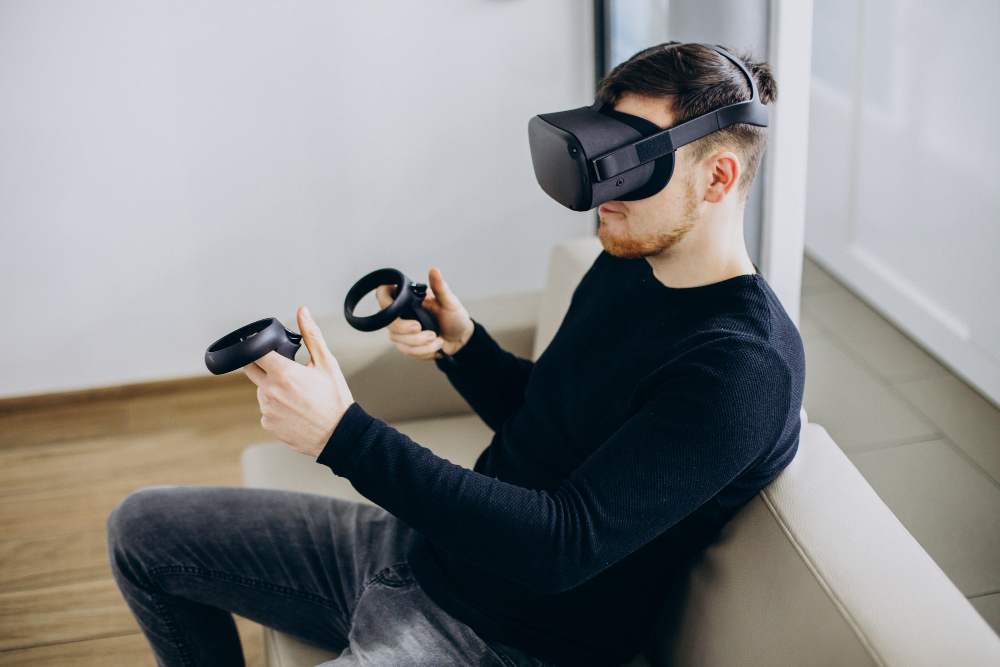
VR Gaming has evolved from a futuristic concept into one of the most transformative experiences in modern entertainment. In 2025, it stands at the front line of innovation, connecting technology, creativity, and human emotion in a way that traditional gaming cannot replicate. Players today don’t just play — they live inside digital worlds that respond to their movements, decisions, and even emotions. The evolution of VR has redefined how we see, feel, and interact with virtual environments, making every experience deeply personal and unforgettable.
The Rise of Virtual Reality as a Mainstream Platform
What began as an experimental niche a decade ago has now grown into a global phenomenon. With advancements in graphics, haptic feedback, and motion tracking, VR Gaming in 2025 no longer requires bulky setups or expensive systems. Devices like Meta Quest 4, Apple Vision Pro, and PlayStation VR2 have streamlined accessibility, allowing players to experience immersive worlds from living rooms, classrooms, and training centers alike.
The technology behind VR immersion is driven by precision engineering — ultra-high refresh rates, wireless connectivity, and adaptive eye tracking that reads player focus to deliver smoother interactions. What makes today’s experiences revolutionary is the emotional realism. Game design now integrates subtle touch sensations, temperature shifts, and sound depth that mimic the physical world. Every sense participates, pulling players deeper into the illusion of presence.
Immersive Storytelling Through VR
Storytelling has always been the soul of gaming, and VR takes it to new heights. Rather than watching a narrative unfold, players become its heartbeat. Developers craft games where perspective and empathy merge, allowing participants to live stories instead of observing them.
Titles like Echoes of Reality and Chrono Voyage showcase how VR Gaming transcends conventional storytelling. These experiences allow decisions to shape worlds dynamically, merging cinematic design with human emotion. In one breathtaking sequence, a player’s heartbeat controls environmental pacing, making fear or excitement part of gameplay logic.
The power of perspective makes every scene feel alive. Standing face-to-face with a character in virtual reality transforms simple dialogue into genuine human connection. For many players, these experiences feel as emotionally real as physical memories.
Real-World Applications Beyond Entertainment
While entertainment lies at the heart of VR Gaming, its influence spreads far beyond play. Industries like education, healthcare, and corporate training have harnessed VR’s immersive potential to change how people learn and work.
In schools, virtual learning environments transport students into historical recreations, biological simulations, or outer space journeys. Medical professionals practice complex surgeries in VR labs that replicate the sensations of real procedures with incredible accuracy. In sports and defense sectors, VR is reshaping training by providing zero-risk repetitions in authentic environments.
This convergence of gaming design and real-world utility proves that virtual reality is not a gimmick; it is a technology of transformation. The gaming sector simply led the way.
Multiplayer Interaction and Virtual Social Worlds
The social dimension of VR Gaming is where it becomes a true cultural force. Players don’t just interact; they inhabit shared worlds. Multiplayer environments have evolved into thriving digital societies built around collaboration, creativity, and connection.
Games such as Zenith: Infinite Realms and Population: One Reloaded showcase community-driven experiences where players craft friendships, form teams, and build digital legacies together. Social VR spaces like Horizon Worlds or VRChat allow users to express identity beyond screens through body language, voice inflection, and movement.
What separates these spaces from traditional online gaming is the immediacy of presence. Virtual handshakes, shared laughter, or synchronized gameplay create emotional moments that rival real-world experiences. In many cases, virtual communities have become genuine support networks, helping people overcome isolation and build lasting bonds.
The Science of Motion and Sensory Design
The evolution of hardware plays a vital role in the expansion of VR Gaming. Modern headsets integrate motion sensors that track subtle gestures, while haptic gloves and suits simulate texture, resistance, and pressure. These tools bridge the gap between the physical and digital, allowing every punch, stretch, and step to feel natural.
For instance, advanced haptics in systems like bHaptics or Teslasuit distribute vibrations across the body to mimic sensations such as running through rain or firing a weapon. Adaptive triggers and variable resistance in controllers replicate real-world tension, giving weight to every movement.
Meanwhile, spatial audio has reached cinematic precision. Players hear whispers behind them, echoes in vast chambers, or rhythmic footsteps in sync with their motion. This multisensory fusion enhances realism, transforming virtual space into a fully inhabitable dimension.
The Economics of a Virtual Future
The economic landscape of VR Gaming is expanding rapidly, driven by accessibility and innovation. Global revenue has surpassed previous projections, with VR titles consistently ranking among the top-performing genres in digital marketplaces. Subscription-based ecosystems now allow players to access vast VR libraries on demand, reducing barriers to entry.
Independent developers thrive as well, taking advantage of streamlined engines like Unreal 5 VR and Unity XR. These tools allow small teams to produce world-class experiences, leveling the creative field. Corporate collaborations with film, fashion, and sports brands generate cross-industry partnerships, connecting entertainment sectors in unprecedented ways.
Even retail and marketing industries have evolved through VR platforms, offering interactive shopping, virtual concerts, and live product previews. The digital economy thrives on immersion, with VR at its center.
The Psychology of Presence and Emotional Impact
At its core, VR connects deeper than sight and sound—it touches emotion. The psychology of presence is the hallmark of VR Gaming, where immersion triggers empathy and engagement unlike any other medium.
Games such as Lone Echo III or Before Your Eyes VR Edition evoke true emotional responses by placing players inside the minds and memories of their characters. Scientific studies confirm that the brain perceives virtual events similarly to real experiences, which is why VR can evoke awe, fear, or nostalgia with genuine intensity.
Players recall these experiences not as gameplay moments but as personal memories—proof that immersion can redefine emotional storytelling. With this psychological depth, VR isn’t just about gaming anymore; it’s about shared human emotion reframed through technology.
Accessibility and Design Ethics
Designers are investing heavily in making VR inclusive. Modern systems incorporate adaptive settings for players with mobility or sensory limitations. Customizable interfaces, voice-command options, and eye-tracking systems ensure access for all.
Ethical development has also become central. Developers emphasize consent-based interactions, user privacy, and moderation in persistent social spaces. These frameworks ensure that the excitement of VR remains safe and respectful for every participant.
The advancement of accessibility aligns with the gaming community’s growing call for equality and transparency. It ensures that the universe of virtual reality remains open, fair, and representative of everyone who dreams within it.
The Integration of AI and Adaptive Learning
Artificial intelligence has become the silent architect shaping modern VR Gaming. Machine learning systems analyze player habits and build adaptive game worlds that evolve organically. Enemies learn from past battles, narratives react to unspoken player choices, and environments shift with physiological feedback such as stress levels or reaction time.
Some advanced titles even merge biometric sensors to measure pulse or gaze movement, letting the game mirror emotions in real time. This adaptive realism closes the gap between digital and biological response, setting a new creative standard.
Through AI-driven innovation, VR evolves from scripted experience to living narrative—a world that understands and reflects each player uniquely.
The Social and Cultural Renaissance of VR
Culturally, virtual reality has transcended gaming. It has become a platform for expression, artistry, and activism. Events like VR music festivals, film premieres, and international conferences showcase how interconnected the digital and physical worlds have become.
Artists design interactive installations where visitors sculpt light, manipulate time, or compose music through physical motion. Meanwhile, social causes gain a new storytelling medium capable of generating empathy on a profound scale. When players walk through the perspective of another person’s life, awareness becomes understanding.
This cultural shift reinforces the power of interactive media to inform, inspire, and unite. VR isn’t just transforming entertainment—it’s transforming communication and creativity altogether.
The Road Ahead for Virtual Reality
Developers envision VR Gaming intertwining seamlessly with every aspect of daily life. Advances in neural interfaces and lightweight optics suggest a future where people engage with digital worlds as naturally as physical reality. Portable, wireless setups and 8K microdisplays are already turning science fiction into practicality.
Multi-sensory experiences will continue advancing, integrating smell, taste, and environmental realism into gameplay. As connectivity improves through 5G and 6G, global multiplayer VR spaces can host millions of users synchronously with near-zero latency.
The future promises limitless creative frontiers, where imagination and technology merge. Every innovation brings us closer to the ideal of complete presence—a state where the digital world doesn’t just exist but feels profoundly alive.
A Connected Human Experience
Beneath all technology, VR Gaming ultimately revolves around human connection. It allows people to experience empathy, courage, and wonder from perspectives beyond their own. What once was futuristic fantasy is now everyday reality—a digital frontier that bridges imagination and existence.
Players step into dreams, explore impossible worlds, and build friendships that transcend geography. Virtual reality makes art, education, and emotion intersect in ways no other medium can achieve. In 2025, VR is not simply a technology; it is the continuation of humanity’s most timeless pursuit—storytelling through experience.
Read also:
fortnite wrapped 2024
skillmachine net
fortnite gg wrapped
fortnite.gg wrapped 2024